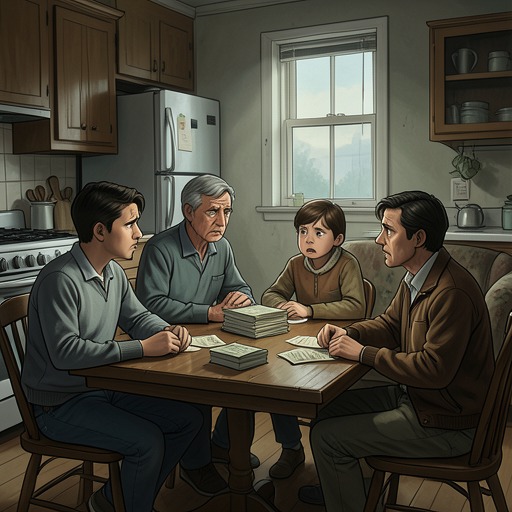
Jackson family’s financial insecurity
On the Come UpJackson family’s financial insecurity is not a passing hardship but a recurring force that constrains the Jacksons’ housing, food, education, and daily decisions. The family’s circumstances worsen through overlapping setbacks: Jayda loses her church job after riot damage strains the church budget, while rent, utilities, and groceries remain difficult to cover. Assistance offers temporary relief, but it does not remove the insecurity that determines which choices are available to the family.
Income, Housing, and Utility Pressure
Jayda explains that the church daycare was damaged during the riots and that its insurance would not cover the repairs. The pastor and elders adjusted the budget to pay for them, and Jayda was let go. The loss of work comes amid immediate financial strain: the family has no gas, and the previous month they received an eviction notice. Jayda used most of her paycheck for rent, leaving the household to eat sandwiches until her next payday.
Housing remains precarious later. Ms. Lewis asks where her money is and warns that this is the last time she will tolerate nonpayment before making the family leave. The prospect of losing their home is reduced to a stark word in Brianna’s mind: homelessness. The warning makes clear that arrears are not an abstract concern; they put the family’s continued shelter at risk.
Utility debt creates another point of crisis. Jayda tells the family that the electric company has shut off the power because they are behind on a payment. Brianna realizes that Law’s chain might have been pawned to cover the bill, connecting a valued family possession to the basic need for electricity. When Jayda insists she is trying, she names the measures already taken: going to interviews, leaving school so the children can have food, and pleading with the church not to dismiss her. Granddaddy responds by taking out his wallet and asking how much the bill is, turning family support into immediate practical assistance.
Food Insecurity and Aid
Food shortages are measured in specific quantities rather than general unease. During the second day of winter break, Brianna counts eighteen items: eight eggs, four apples, two sticks of butter, jars of strawberry jelly and peanut butter, a gallon each of milk and orange juice, and a loaf of bread. The freezer holds a ten-pound bag of chicken, peas, and corn, enough for dinner that night and the next, but not a clear plan for what comes afterward. Christmas itself becomes uncertain because the family cannot count on having enough food.
A community giveaway provides a box of groceries, but the scene exposes the limits and emotional cost of assistance. At the community center on Ash, cars fill the parking lot, an eighteen-wheeler carries boxes, and people line up before eight o’clock. The giveaway line is later shut down, and people waiting outside are told to leave, including a mother carrying a baby who pleads for food. Jayda carries a box home, but Brianna knows they cannot give anything away: the family needs every item. Receiving help therefore brings relief without creating a surplus that could be shared with others in need.
Jayda also accepts support from relatives and public assistance. She says Aunt Pooh plans to bring groceries later in the week; Jayda nearly refuses, but the household’s needs make acceptance difficult to avoid. Later she reports receiving her EBT card, while frozen meat is being put into the freezer. These sources of aid help fill immediate gaps, but the repeated need for groceries and benefits shows that the family’s food security remains fragile.
Choices Made Under Constraint
The pressure of the household budget narrows educational and career choices as well as daily consumption. Brianna learns that Jayda had received acceptance letters from colleges, but the nearest school was three hours away. Jayda says she had to stay in the area, and later tells the family that she withdrew from school. She explains that the decision was made so the children could have food. Education is thus not simply postponed by preference: distance, income, work, and caregiving obligations combine to make leaving school appear necessary.
Jayda’s withdrawal is part of a wider effort to keep the household functioning. She seeks work through interviews, tries to keep the family housed, and struggles to feed the children after losing her church position. Her insistence that she is trying sits beside concrete evidence of what her effort cannot guarantee: rent remains overdue, the power is cut, and groceries require outside help. The family’s resilience is visible, but it does not make the costs of scarcity disappear.
Effects on Brianna and the Wider Story
Financial strain shapes Brianna’s understanding of her family’s circumstances and the choices she sees around her. She recognizes that Jayda’s efforts do not mean everything is all right, recalling the lack of gas, the eviction notice, the near-total use of Jayda’s paycheck for rent, and the meals of sandwiches. Later, in the darkened home, she connects the unpaid light bill with the possibility of pawning Law’s chain. Money problems enter family life as immediate decisions about what can be sold, eaten, paid, or put aside.
The pressure also frames Brianna’s pursuit of a rap career. Aunt Pooh has warned her that, as a girl trying to become a rapper, she will have to work harder for less respect, be as cutthroat as her male peers, and conceal weakness to survive. That advice identifies gendered barriers in the music industry; the household’s financial insecurity gives Brianna’s ambitions a material context as well. The evidence does not reduce her artistic goals to a means of earning money, but it shows that her family’s limited resources form part of the world in which she tries to build a future.
Across these episodes, insecurity recurs through different thresholds: the rent payment that stands between the family and eviction, the last flour used for breakfast, a counted supply of food, the closed giveaway line, the power company’s overdue bill, and the decision to leave school. Aid from relatives, public benefits, and Granddaddy eases particular emergencies, but the pattern remains unsettled. Poverty functions in the story not as background decoration but as pressure that repeatedly shapes the Jacksons’ choices and the sacrifices required to keep the household going.